
How to Restore Water-Damaged Vintage Photos | BIGBROSTUDIO
Severely stuck or water-damaged old photos? Discover how our master artist revives delicate facial details by hand. Zero risk: Preview first, pay after approval.
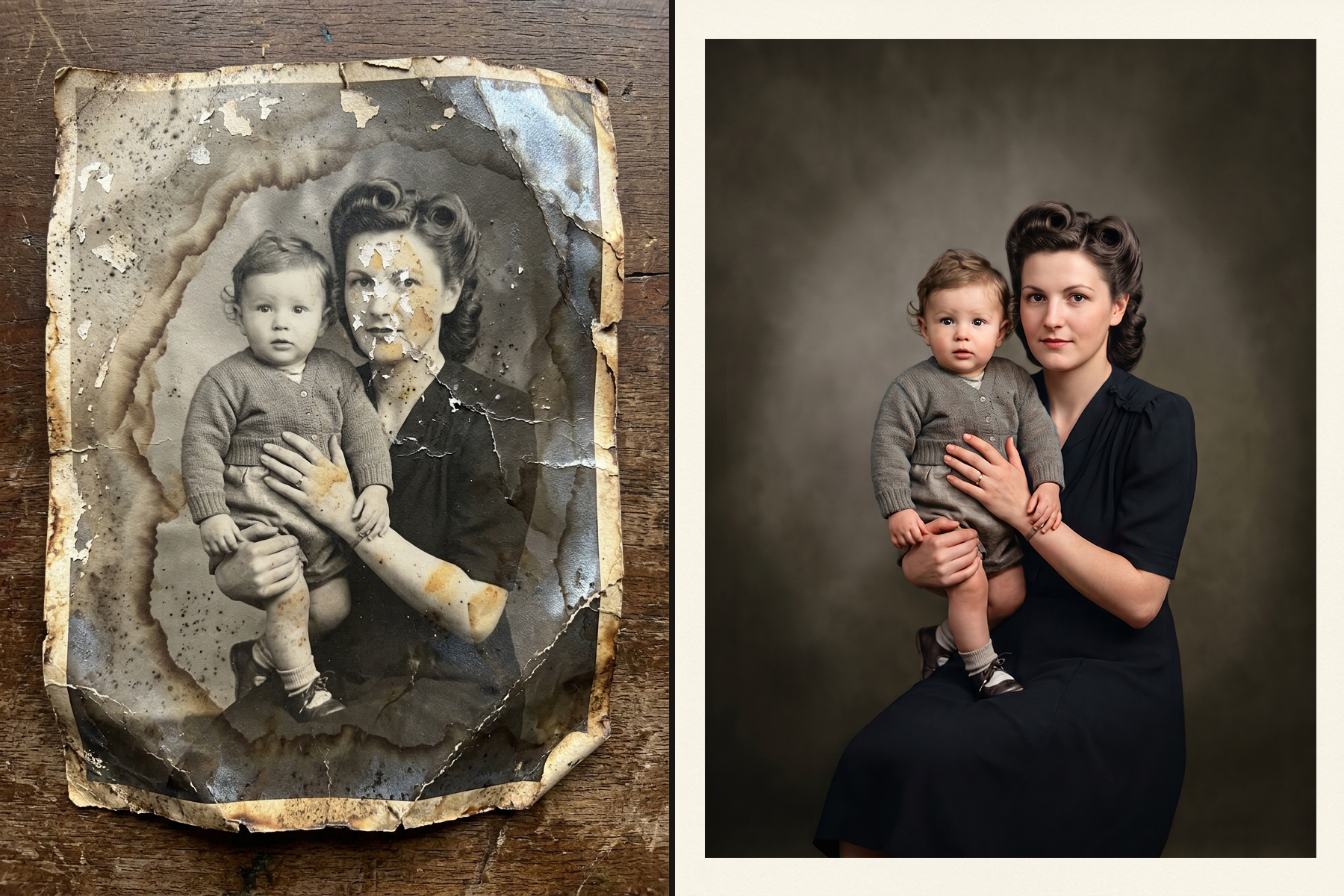
Among all the restoration commissions entrusted to our studio, vintage photographs damaged by water and moisture are always the most heartbreaking.
Disasters rarely announce themselves: a torrential summer downpour flooding a basement storage box, a concealed plumbing leak within an old apartment wall, or decades of relentless dampness seeping through attic rafters.
When families frantically retrieve their cherished albums, their hearts sink. The photographic paper swells and buckles like corrugated cardboard; the surface is marred by dark brown mineral tide marks. Worse still, as the dried emulsion flakes and adheres to the framing glass, delicate facial features—a grandmother’s gentle smile, a father’s laughing eyes—are buried beneath milky silver stains, scratches, and stubborn mildew.
Naturally, many patrons initially turn to popular one-click "AI enhancement" smartphone apps. Yet within seconds, the algorithmic results inevitably evoke frustration or outright dread: The artificial neural network cannot distinguish a dried water tide line from a natural facial wrinkle, transforming water stains into horrifying scars, hallucinating plastic skin textures, and pasting lifeless, artificial eyes that strip away the ancestor's genuine soul.
Why does automated AI fail so dismally when confronting water-damaged heirlooms?
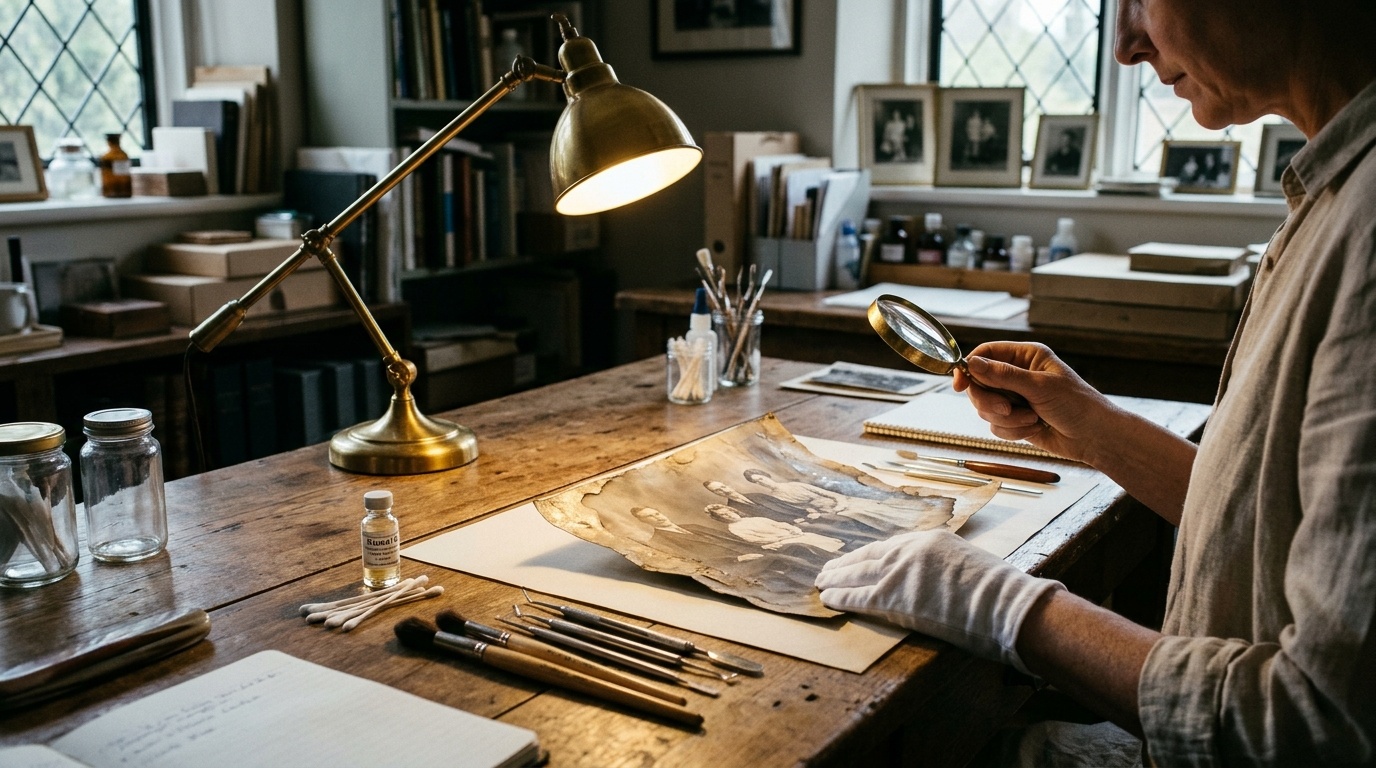
- The Chemistry of Water Damage: Why Algorithms Hallucinate
To understand why automated software fails, one must understand the physical anatomy of historical photography.
Classic mid-20th-century portraits were crafted using the silver gelatin process. Microscopic metallic silver grains are suspended within a delicate gelatin emulsion layer resting on a cotton rag paper base. When submerged or exposed to heavy moisture:
- The gelatin swells and softens, causing colloidal silver particles to dissolve and migrate outward. As moisture evaporates, dissolved salts and oxidized silver crystallize along the liquid perimeter, creating the notorious "coffee-ring effect" (water tide lines);
- Silver mirroring occurs where silver ions migrate to the surface, leaving an iridescent, metallic haze that blinds standard scanners;
- Cotton paper fibers expand unevenly, permanently warping the physical structure into undulating waves.
Modern commercial AI upscalers rely entirely on probabilistic guesswork trained on pristine modern digital portraits. When faced with an organic, wavy water tide mark traversing an eye or cheekbone, the algorithm has no conceptual awareness that "this is foreign mineral residue." It naively treats the dark stain as an anatomical feature, distorting bone structure and wiping away authentic vintage dignity.
- Master ABiao's Four-Step Artisan Conservation Workflow
True archival restoration demands the precision of a conservator and the sensitivity of a master painter. Under high-magnification monitors and calibrated lighting, we restore each portrait stroke by stroke.
Step 1: Multi-Frequency Separation and Stain Decoupling Using advanced frequency separation, we isolate the surface water rings, yellowish oxidation stains, and mildew deposits from the underlying photographic emulsion. This delicate phase peels away the muddy veil without disturbing the surviving silver tones beneath.
Step 2: Anatomical Facial and Skeletal Reconstruction When water has dissolved critical facial landmarks—an eyelid contour, the crease of a smile, or lip volume—our master artist reconstructs the underlying bone structure. Guided by the subject's intact facial geometry and reference photographs of family members, we delicately redraw anatomical depth with pressure-sensitive digital brushes, returning authentic life and sparkle to the gaze.
Step 3: Silver-Gelatin Analog Grain Synthesis Blank digital smoothing is an artistic sin in our studio. Where emulsion was stripped away by water, we analyze the surrounding native grain structure and synthesize matching analog silver halide grain. Even inspected under 300% magnification, the restored regions harmonize seamlessly with the historic print.
Step 4: Chiaroscuro Harmonization and Archival Giclée Output Finally, we eliminate artificial glare caused by paper buckling, harmonizing the overall tonal palette to preserve the warm, dignified atmosphere of vintage studio portraiture. The finished artwork is printed on 100% acid-free German cotton rag paper using 12-color archival pigment inks, ensuring longevity that withstands the centuries ahead.
- Deepening Your Family Chronicle: Beyond Single Photo Repair
Restoring a water-damaged heirloom is often the first step in a family's journey toward honoring their lineage. At BIGBROSTUDIO, we offer seamless specialized extensions to keep your family memories alive:
- Cross-Generational Reunion Portraits:
Did a beloved grandparent depart before your wedding day or before meeting your children? Our studio specializes in seamlessly integrating restored archival portraits into modern living family photography with anatomical accuracy and natural ambient light. Discover our craft at: Reunion Memorial Portraits Services.
- Museum-Grade Framing and Fine Art Styles:
A revived memory deserves physical permanence. Explore our solid North American walnut framing, archival museum mat boards, and anti-reflective museum glass at: Framing & Fine Art Styles Gallery.
- Explore Complete Restoration Portfolios:
If your heirloom suffers from severe tearing, mold infestation, or silver mirroring, explore our comprehensive case studies at: Artisan Photo Restoration Services.
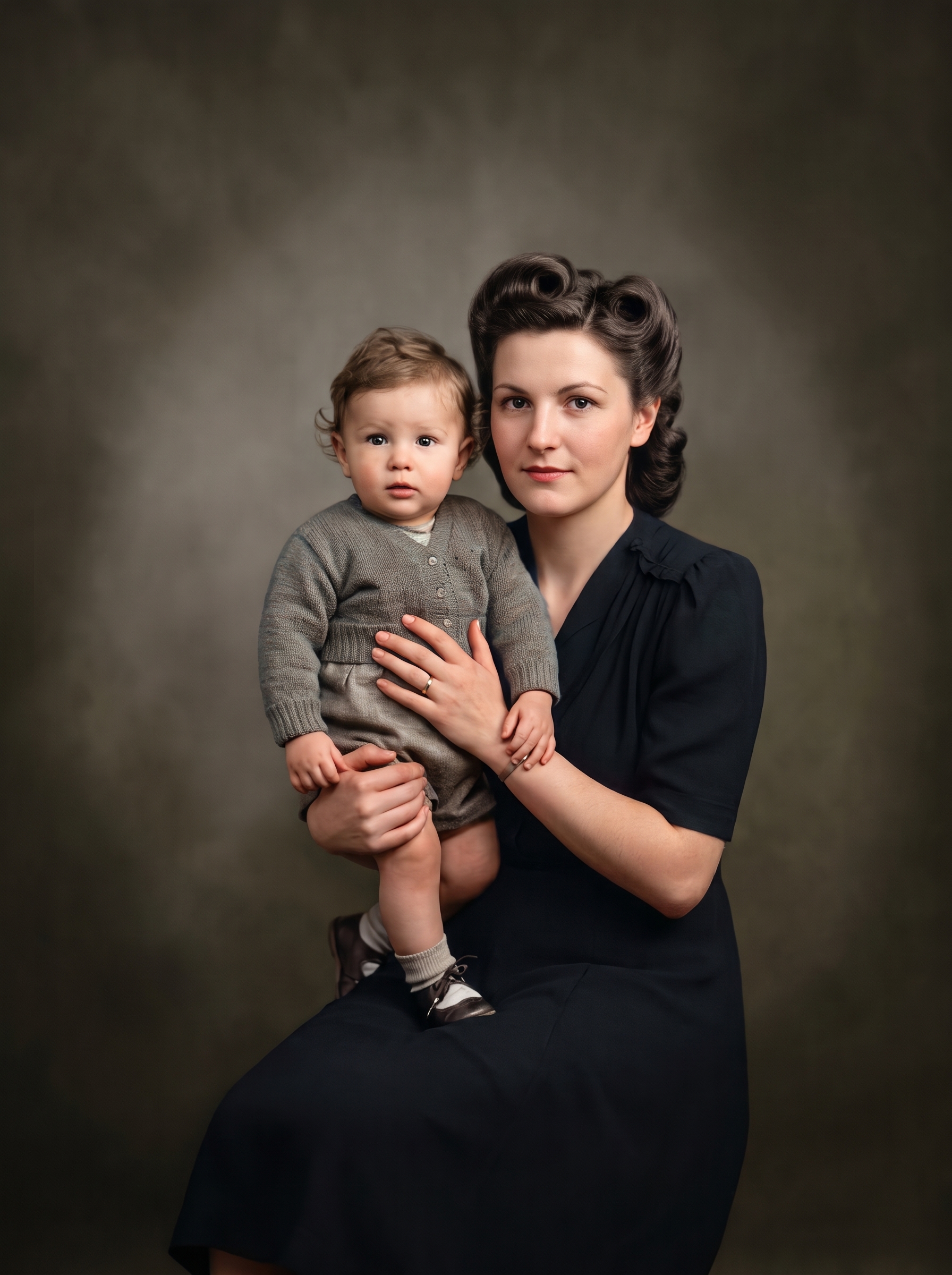
- Zero-Risk Assurance: Preview First, Pay After Approval
We understand that an old photograph is never just paper—it is an irreplaceable vessel of love, identity, and family heritage. Entrusting it to an online studio can feel daunting: "Will it look like my mother?" "What if the result looks artificial?"
At BIGBROSTUDIO, we operate on a sacred zero-risk principle:
Zero deposit required. We restore first. You inspect the high-resolution preview. You only pay once you are completely in love with the result.
No matter how severe the water damage or how brittle the paper, simply snap a well-lit photo of your heirloom with your smartphone and send it to our desk. Our master artist will provide a candid structural assessment free of charge. You will receive a watermarked preview for your family's review, with multiple rounds of fine-tuning welcome.
Closing Invitation: Have a delicate family heirloom damaged by water or moisture? Send us a snapshot for a free assessment. You only pay once you fall in love with the restored preview.
For additional details regarding our preservation standards or delivery timelines, visit our: Frequently Asked Questions (FAQ) or leave a message directly through our studio desk below.
Reader Discussions & Patron Stories
Authentic thoughts and artistic conversations. The artist personally replies to every patron when taking a break from the easel.
Join the Discussion
Share your thoughts, the story behind your vintage photo, or ask the artist a question. ABiao replies personally.
Hurricane flooding submerged our basement storage last summer, and my family albums sat underwater for two full days. When we finally dredged them out, the pages were glued together and the sole surviving 1940s photo of my grandmother holding my infant father had swollen with dark brown tide lines and peeling emulsion. I was heartbroken. I tried three AI restoration apps, but they distorted her face into an alien caricature. In desperation, I reached out to Master ABiao. When the preview arrived, my wife broke down in tears. The ugly water rings were completely gone, yet every tender crease around grandmother's eyes and the delicate knit texture of my father's cardigan were faithfully preserved. The zero-deposit preview gave us complete peace of mind. Truly priceless craftsmanship!
This article is so informative! Last month a hidden pipe leak in our attic dripped over my great-grandfather's 1930s railway portrait, causing half the paper to buckle like corrugated cardboard. I was about to flatten it under a pile of heavy encyclopedias, but your breakdown warned me in time: dried, brittle fibers will crack and shatter if pressed forcefully! If half the photo is warped with faint yellow water marks, can we simply take a well-lit phone picture and send it over for your initial assessment?
The explanation of the 'coffee-ring effect' is spot on! I tried digitally restoring two family snapshots myself, and those dark, crusty water rings were an absolute nightmare—standard cloning stamps just left smudged, muddy patches. Seeing how seamlessly you removed the stains while redrawing the lost catchlights and nasal contours shows decades of true artistic mastery. How are your German acid-free archival prints packaged for delivery to Lyon, France? Is the crate moisture-resistant?