
Reunion Across Time and Space: Bringing Deceased Loved Ones into Family Portraits | Artist's Notes
In the depths of many families' memories, a lingering regret remains - the loss of a loved one who departed too soon, missing the daughter's wedding, never meeting the newborn grandchild, and leaving an empty space in the family photo. Many clients ask: "Can you seamlessly integrate an old photo of
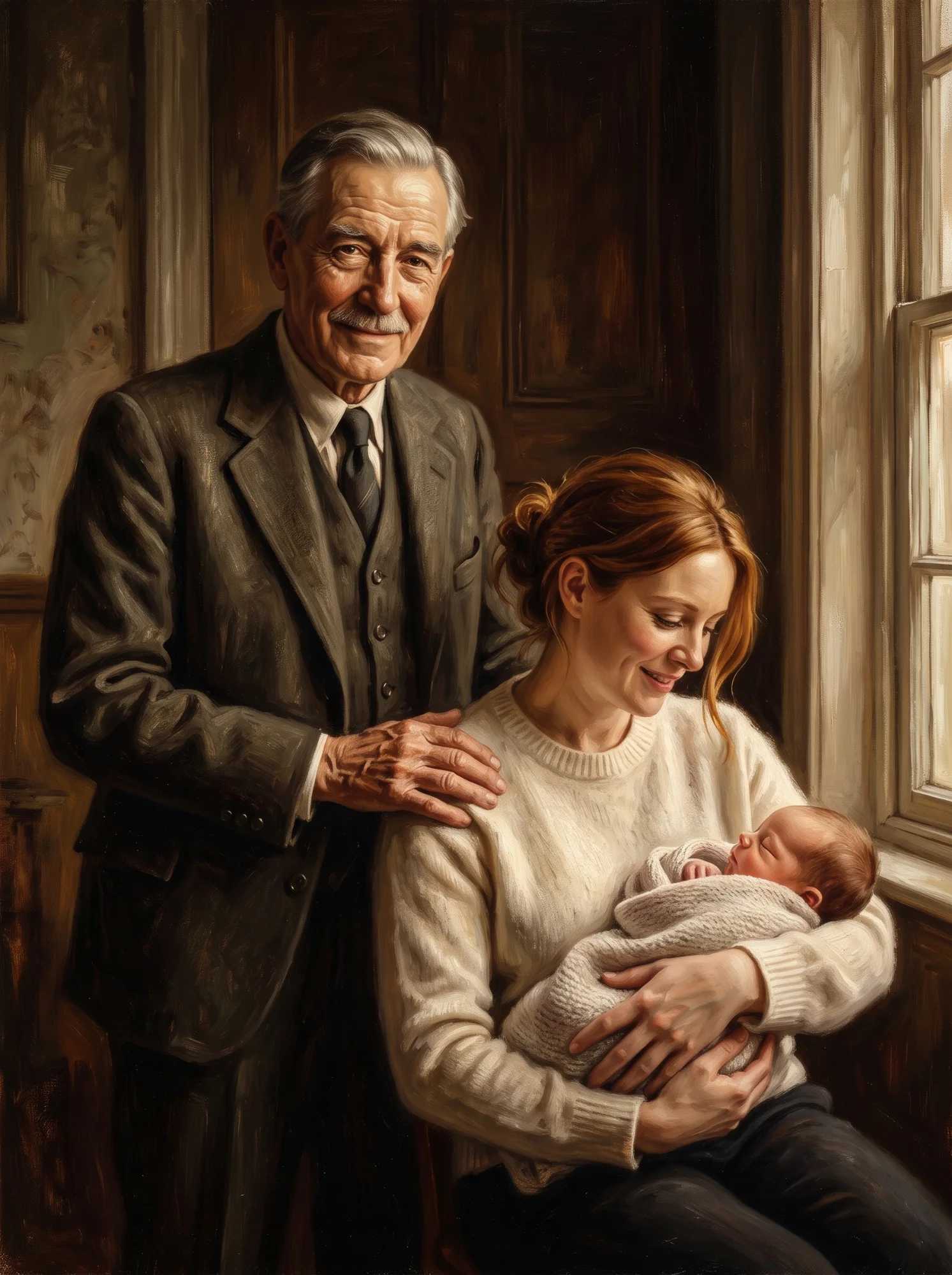
In our studio's daily mailbox, we receive letters like this every few days. The words in these letters are often light, but the weight behind them is crushing:
"Artist, my father passed away five years ago. This year, I got married, and we left an empty chair for my mother at the wedding. I want to ask, can you combine my father's old solo photo with our family portrait from the wedding day? I don't want to see a cold, empty chair in the photo; I hope my mother can stand beside us, smiling, just like before."
There's also a young mother who sent us a faded, brittle black-and-white photo: "This is my father; he passed away when I was two years old. Now my daughter is four years old, and she looks just like him when he was young. I want my father to hold my daughter, even if it's just in a painting."
Such commissions are often referred to as "combining deceased loved ones into family photos" overseas. For many families who have experienced the pain of loss, this is not just a simple image processing task; it's a long-overdue reunion, a healing process for the wounds torn by time, and a chance for closure in the warmth of light and shadow.
![A three-stage comparison of combining deceased loved ones into family photos]
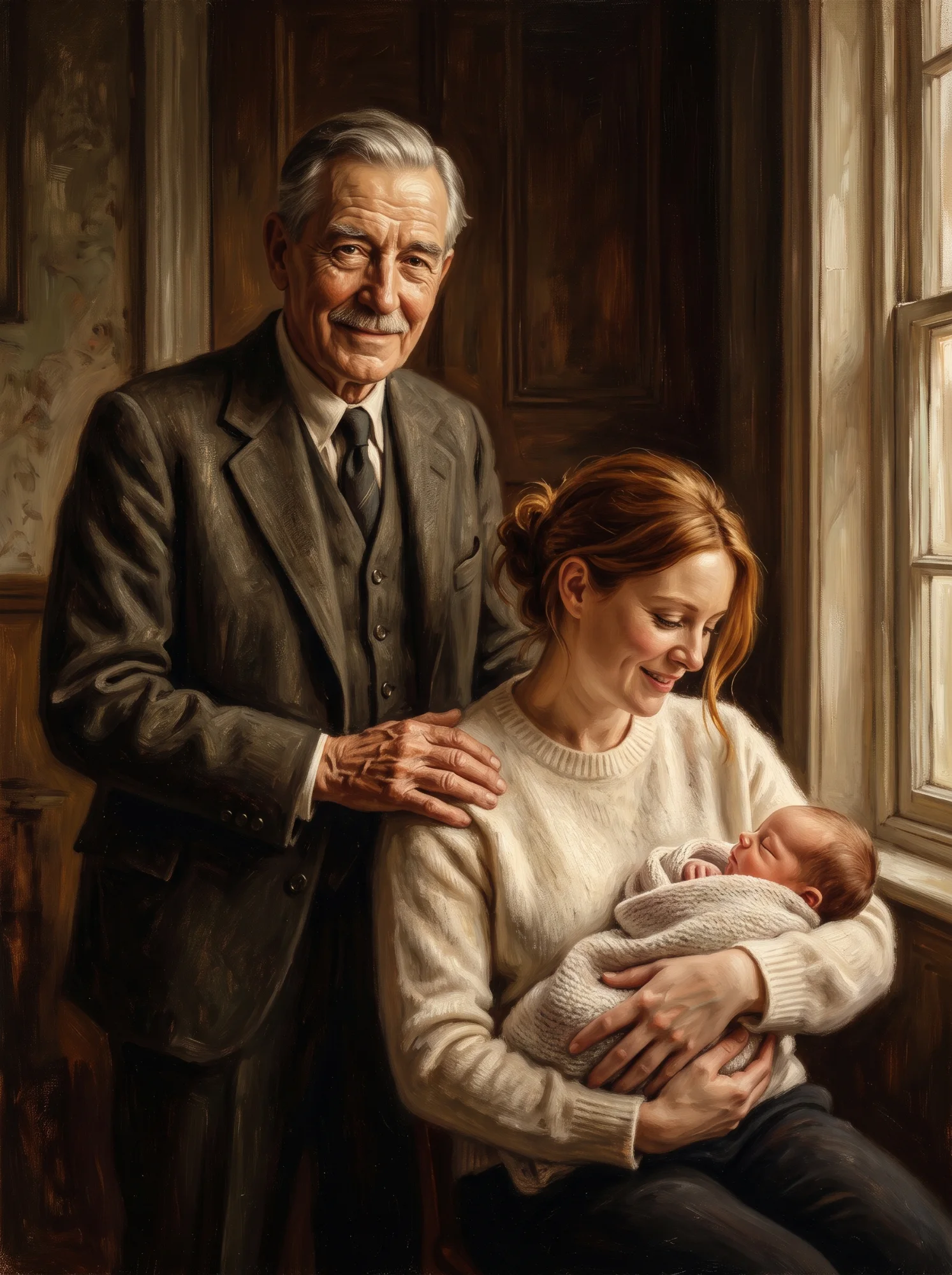
I. Why do most composite photos look "fake"?
Many people try to find ordinary online photo editing shops or use photo editing software to composite images before coming to our studio. However, the results often leave them feeling unsatisfied: The deceased family member looks like a flat paper cutout floating in the middle of the group; or their face is pale and gray, with empty eyes staring at the camera, while the people around them are laughing; in severe cases, the lighting is completely mismatched, creating an unsettling sense of discord.
Why is this? Because in real life, when people stand together, there are physical laws and interactions at play. When two people stand close to each other, there's not only the subtle leaning of their shoulders and the gentle pressure of their clothing, but also the shadows cast on each other, the soft reflections from the surrounding walls and windows, and the subtle resonance of their gazes.
To put two people who have never met in the same space into one painting, simply cutting and pasting is not enough. It requires the artist to be like a director, rebuilding a stage with real gravity, temperature, and light and shadow for them.
II. The four-step craftsmanship of our artists
Step 1: Recalculating the horizon line and skeletal perspective. The old photo of the family member may have been taken from above or from a low angle; while modern family portraits are often taken with a smartphone at eye level. If we simply paste the head onto the new photo, the family member's neck and head angle will look extremely awkward. The first thing our artist does is calculate the horizon line (Eye Level) and vanishing point of the two photos. We need to recalculate the family member's spinal tilt, center of gravity, and gaze direction as if they were really standing or sitting beside their loved ones. Only when the skeleton is correctly positioned can the person in the painting "stand firmly and sit comfortably".
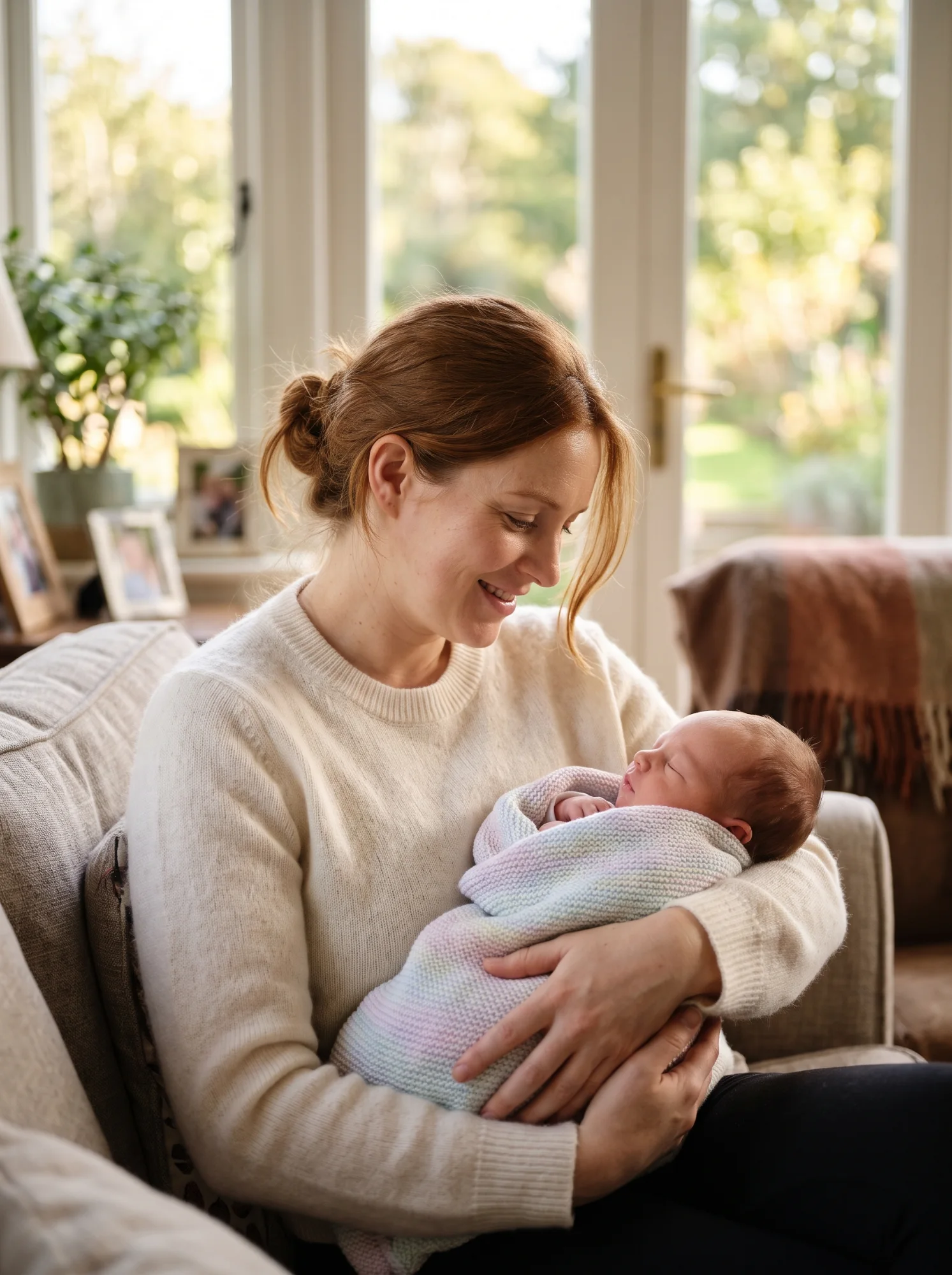
Step 2: Completely resetting the environmental lighting in 3D. This is the most critical step in determining the vividness of the entire painting. Old photos were often taken in old photo studios with harsh flash lighting or yellowed incandescent bulbs; while modern family portraits may be taken in the soft, warm light of a living room window. Our artist must establish a 3D light and shadow model in their mind: which areas of the family member's face should be illuminated by the soft, ambient light? How will the shallow color of the daughter's sweater reflect a warm, gentle glow onto the family member's dark suit? And how will the family member's arm, resting on the armrest or the daughter's shoulder, cast a contact shadow on the clothing? Every highlight and every layer of shadow must be carefully hand-painted, allowing the family member to truly bask in the warm light of the family's presence.
![A portrait of a deceased grandfather embracing his adult granddaughter across time and space]
Step 3: Seamless Integration of Texture and Image Quality
The old photographs of our elders often have low resolution, and may even be accompanied by blurry noise, creases, or the silver mirroring effect of old photo paper. In contrast, modern digital photos are sharp and clear, revealing every detail down to the pores. When two images with vastly different qualities are combined, the discrepancy is immediately noticeable to the naked eye. The artist must first perform a meticulous restoration of the elder's facial features, removing the effects of time and revealing the highlights in their eyes and the fine lines at the corners. Next, the entire work undergoes a comprehensive artistic harmonization - either through the use of thick, heavy brushstrokes reminiscent of classic oil paintings (Impasto), or by applying a uniform layer of subtle, warm film grain, creating a cohesive and natural look that makes all the characters in the painting seem as though they were born on the same vintage linen canvas.
Step 4: Warm and Genuine Physical Interactions
This is the most heartwarming and touching aspect of our work. In many composite works, the characters are often stiff and parallel to each other, like wooden posts. However, in our creations, the elder's hand will naturally rest on the daughter's shoulder, or the granddaughter's small hand will gently cover the grandfather's weathered and aged hand. The fabric will also produce realistic wrinkles and creases due to the natural contact. These subtle touches are the fundamental difference between a "cold montage" and a "warm hug".
III. A Perfect Portrait on the Living Room Wall
Recently, we completed a work for a client named Emma from Manchester, UK. Her grandfather had passed away when she was young, and never got to see her grow up. On Emma's 30th birthday, her mother received this painting, framed in a deep brown classic wooden frame.
In her letter to our studio, Emma wrote: "When my mother unwrapped the package and saw the painting, she was speechless for five whole minutes. She simply raised her hand and stroked the image of my father's eyes with trembling fingers, tears streaming down her face like a broken string of pearls. She said that my father had always been most concerned about our family's well-being, and if he were alive today, he would definitely be happy to see us thriving. He would be wearing his favorite suit, with a warm and gentle gaze, embracing me and the children. The artist, you have helped our family find the most important missing piece. The painting now hangs on the wall in front of our dining table, and every time we have dinner together, we feel like my grandfather is with us."
IV. Love Never Leaves, It Just Changes Its Way of Watching Over Us
In life, there are often separations that come too suddenly. The unspoken gratitude, the unfulfilled hugs, the empty photo frames - these can become the deepest and most lasting pain for generations. We cannot turn back time, but the artisan's brush and heart can build a bridge of reunion on this small canvas, transcending the boundaries of life and death, and the passage of time.
Life is limited, but love is eternal. If you also have a loved one who has passed away, leaving behind only incomplete photos, consider bringing them to our studio. Let us use our most sincere craftsmanship to create a warm and complete family portrait for you.
Reader Discussions & Patron Stories
Authentic thoughts and artistic conversations. The artist personally replies to every patron when taking a break from the easel.
Join the Discussion
Share your thoughts, the story behind your vintage photo, or ask the artist a question. ABiao replies personally.
The evening the painting arrived, my mother and I held each other and wept for a long time. My grandfather passed away early, long before my wedding and before little Sophie was born. Every family portrait over the years always felt like something irreplaceable was missing. I was terrified an old photo added in would look unnatural or eerie, but seeing the finished piece—his soft gaze, the warm lighting on his hand resting naturally near my shoulder—it felt as though he had stepped back into our lives yesterday. When my aunt visited on Sunday, she gently touched the canvas and whispered, 'That is exactly how your grandfather looked when he was proud of you.' Thank you Master ABiao, you healed a quiet ache in our hearts.
Reading this brought tears to my eyes. My father passed away five years ago, and my younger sister is getting married this summer. Her deepest wish is to have a portrait with our father standing by her side on her wedding day. We contacted several studios before, but their samples looked so stiff and paper-thin, with conflicting shadows and unnatural poses. Reading your breakdown on skeletal alignment and diffused bounce lighting showed me how much true artistry is involved. If we only have an old 1980s black-and-white passport snap and a candid snapshot of our father, can you blend him into modern color wedding photography?
This journal is deeply moving and honest. Anyone with an eye for art immediately notices the difference: automated composites look chillingly plastic and detached, whereas in your painting, the gentle compression on the clothing where arms rest and the subtle bounce light on the fabrics look completely organic. How long does the hand-painted reunion process usually take? And when shipping to Austria, is the framed canvas properly secured against moisture and bumps?