Creases in an Old Wallet: Restoring a Father's Lost Gaze for a 78-Year-Old Son
Kept inside a leather wallet for over six decades, this small vintage portrait suffered catastrophic horizontal fold tears that completely obliterated the father's eyes and nose. Refusing generic AI face-swapping, artist ABiao reconstructed the German gentleman's facial bone anatomy, houndstooth silk tie, and weathered gaze layer by layer, bringing a father's enduring strength back to his 78-year-old son in Vancouver.
Among the countless types of damage that afflict vintage photographs, "wallet photos" are often the most gravely injured, yet by far the most heartbreaking.
They are rarely destroyed by sudden floods or insect damage. Instead, their wounds come from decades of ceaseless, devoted touching. Kept inside the tight folds of a leather bifold wallet, the stiff photographic paper fatigues with every opening and closing, until the emulsion along the creases disintegrates into white powdery dust, literally severing the face of a loved one.
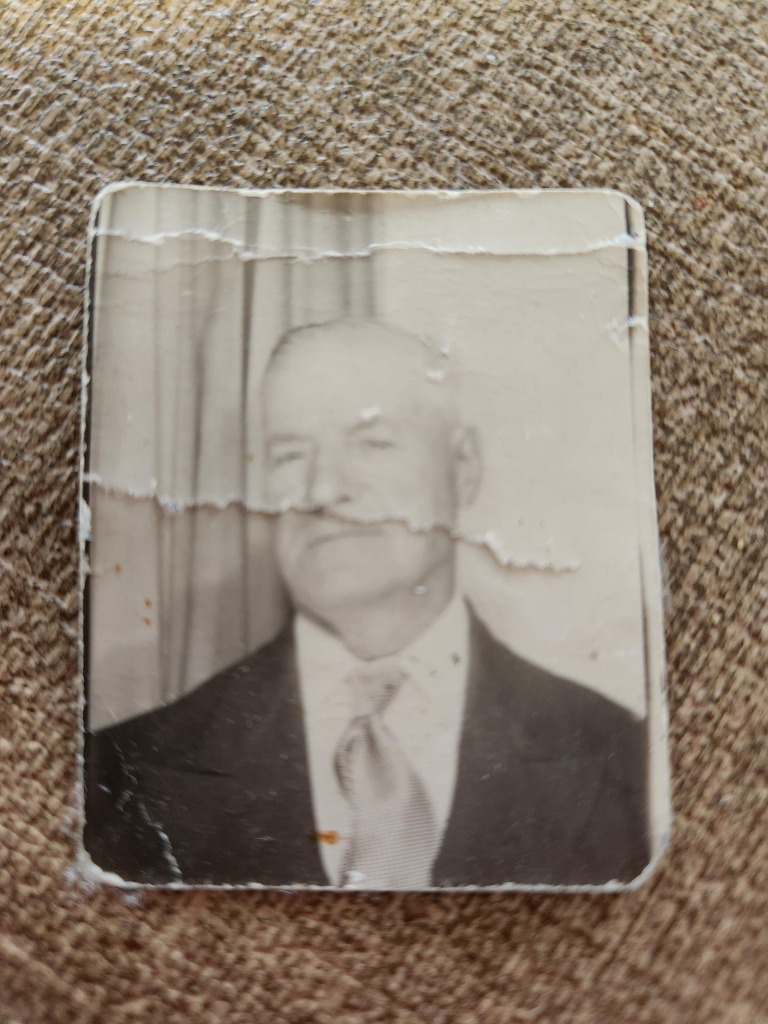
A few days ago, Hannah, a client living in Vancouver, Canada, sent me a scan of a small passport-sized vintage print. The tiny photograph rested on textured tweed fabric: a distinguished gentleman in a formal suit and tie, gazing with quiet dignity. However, two jagged horizontal crease tears had ripped across his forehead and facial features like brutal knife wounds—with the most catastrophic tear slicing directly through the bridge of his nose and both eyes. The ocular region was completely obliterated into empty white paper fibers and faded grey voids.
Hannah wrote in a message filled with emotion:
"Dear Artist, the man in this photograph is my grandfather, Hans Weber. During the grueling post-war reconstruction of 1948, he left Munich alone to work on structural engineering projects in North America to rebuild our family's shattered home. Before boarding the transport train, he had this portrait taken and handed it to my father, Karl, who was only ten years old. My father is 78 today. Since he was ten, this little photo stayed pressed against his chest pocket; as an adult, it moved into his daily leather wallet. For over sixty years, whenever my father faced exhaustion, unemployment, or freezing northern Canadian construction sites, he would pull out this wallet and look into his father's eyes for courage. Last month, Father suffered a mild stroke. When he woke in the hospital room, his speech was slurred, but he desperately pointed at his wallet in the drawer. When we opened it, we realized the photo had finally snapped apart along the folds. Grandfather's eyes were completely erased by white tears... Father wept like a brokenhearted child: 'Papa's eyes are gone... Papa is gone.' I tried several automated restoration services, but AI face-swapping either gave him the face of a plastic model or a vacant wax figure. Please, with your true craftsmanship, can you return my grandfather's real gaze to my father?"
Anatomical Deduction: Reconstructing the Lost Gaze
Reconstructing a portrait whose eyes have been physically severed is the ultimate test of an artist's anatomical knowledge and restraint. Over 80% of human facial recognition hinges on the gaze. If a pupil's focus or eyelid curvature is off by half a millimeter, the person becomes a complete stranger.
Refusing automated AI filters that hallucinate generic facial features, I undertook a meticulous anatomical reconstruction:
- Ocular Orbital Alignment and Direction of Gaze:
Zooming into 1200% magnification, I studied the minute shadow remnants beneath the prominent German brow ridge and the micro-reflection surviving on the edge of the torn tear. Based on mature cranial anatomy, I hand-painted the depth of the eye sockets, the gentle eyelid folds, and subtle crow's feet. I aligned his gaze into a calm, resolute, slightly upward focus—reflecting a father bearing the heavy weight of an immigrant family with unyielding fortitude and quiet affection.
- Restoring Mustache and Dignified Micro-Expressions:
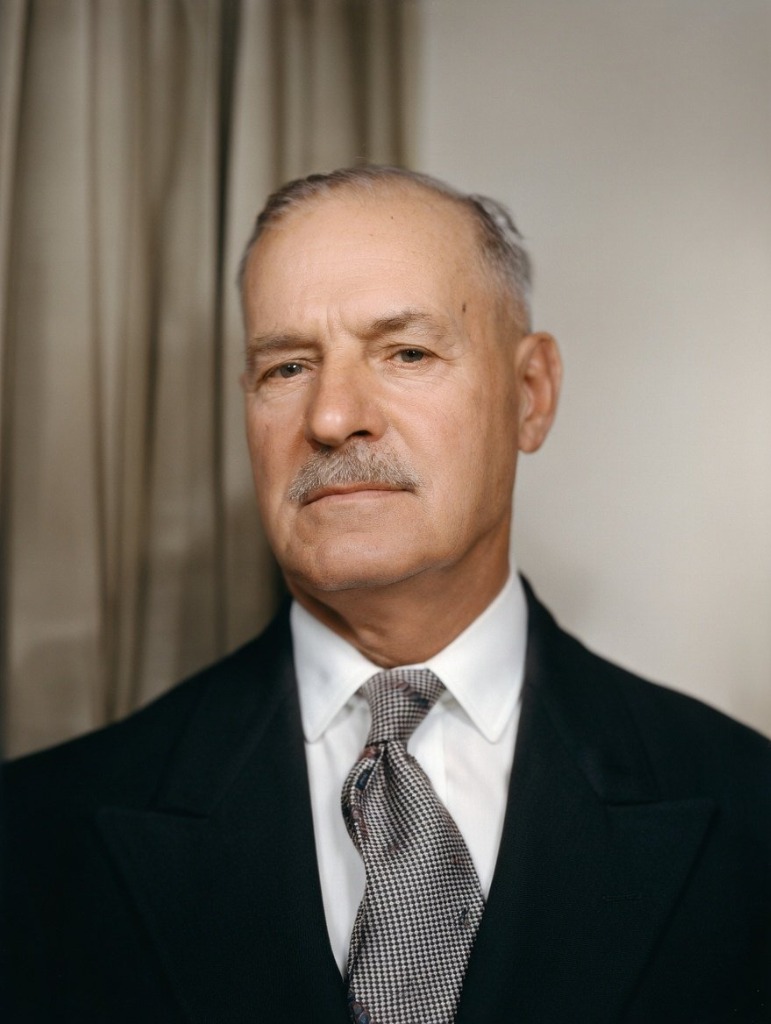
Hans’s lips were firmly set beneath a neatly groomed, salt-and-pepper mustache. Using single-pixel digital brushes, I reconstructed the individual bristled textures of his grey-speckled mustache and cleared away the white fractures across his philtrum, restoring the disciplined nobility of a mid-century craftsman.
- 1940s Houndstooth Woven Silk Tie:
The patterned necktie in the faded original was blurred into grey noise. Grounded in late-1940s European tailoring, I historically recreated the micro-houndstooth geometric woven silk tie in muted silver-grey and dark tones, alongside the rich drape of his black wool double-breasted suit jacket.
- Warm Ambient Studio Atmosphere:
The background drapery was restored with soft warm beige tones, balancing natural vintage grain with lifelike skin vitality, banishing any synthetic digital gloss.
After five days of painstaking digital craftsmanship, when the final catchlight was brushed into his pupils, the father who had been trapped in darkness reopened his eyes.
The Outcome: "Papa, You're Looking at Me Again"
I produced the final archival portrait using museum-grade Giclée printing on 310gsm Hahnemühle Photo Rag cotton paper, hand-mounted into an authentic dark walnut wood frame, and dispatched it via priority courier to Vancouver.
Yesterday morning, Hannah sent me a moving video from the Vancouver rehabilitation center.
Sunlight poured across the hospital bed where 78-year-old Karl sat propped against pillows. As Hannah unwrapped the ribbon and set the framed portrait gently onto his lap, the elderly man went completely motionless.
For thirty seconds, silence filled the room. Then, Karl's trembling, calloused carpenter hands slowly reached out. His index finger gently, reverently traced the glass—first caressing his father's mustache, and finally coming to rest directly over Hans's clear, loving eyes.
Tears welled in the old man's eyes and poured down his weathered cheeks. In a voice choked with tears, he murmured in English with a soft German accent:
"Papa... it is you. You're looking at me again... You never left."
Around the bed, his daughter and nursing staff quietly wiped away tears.
A fragile scrap of paper, kept close to a human heart for over six decades inside a worn leather wallet, carried an entire lifetime of devotion. Time may fracture the physical fibers, but genuine love remains unbreakable. This is the true purpose of photographic restoration: mending the fractures of time with steady hands, so that the dignity and love of those before us can shine brightly once more.
Reader Discussions & Patron Stories
Authentic thoughts and artistic conversations. The artist personally replies to every patron when taking a break from the easel.
Join the Discussion
Share your thoughts, the story behind your vintage photo, or ask the artist a question. ABiao replies personally.
From a structural draftsman's perspective, reversing a tear that severs the ocular axis is an extraordinary technical challenge. A deviation of even 0.5 degrees in pupil convergence destroys the human soul in a face. The artist not only restored correct orbital depth, but rendered the drape of post-war wool tailoring with pinpoint accuracy. Admirable precision.
Father has been home from rehabilitation for two days now. This morning, as the sun hit the living room wall, he sat peacefully in his wheelchair with a gentle smile, looking up at his father's portrait. He whispered: 'Hannah, waking up and knowing Papa is watching over me gives me strength.' ABiao, you saved our family's anchor.
The phrase 'wallet photo' struck a deep chord. Inside my late father's worn bifold was a tiny snapshot of my mother from the 1960s, creased and frayed around every corner. In those decades before cloud storage, that paper tucked inside leather was a traveling man's entire universe.