
Restoring Creased & Cracked Vintage Wallet Photos: A Technical Guide to Facial Bone Reconstruction, Frequency Separation, and Multi-Layer Hand Colorization
Vintage wallet portraits subjected to body heat, bending stress, and emulsion craquelure represent the most severe physical photo damage. Automatic AI filters inevitably melt facial bones, blackout pupils, and produce cheap plastic textures. Master restorer Biao breaks down the complete artisanal restoration pipeline: frequency separation, craniofacial skeletal reconstruction, corneal specular highlights, and subsurface scattering hand-colorization. Lossless 300 DPI print-ready digital deliverables with complimentary $0 previews.
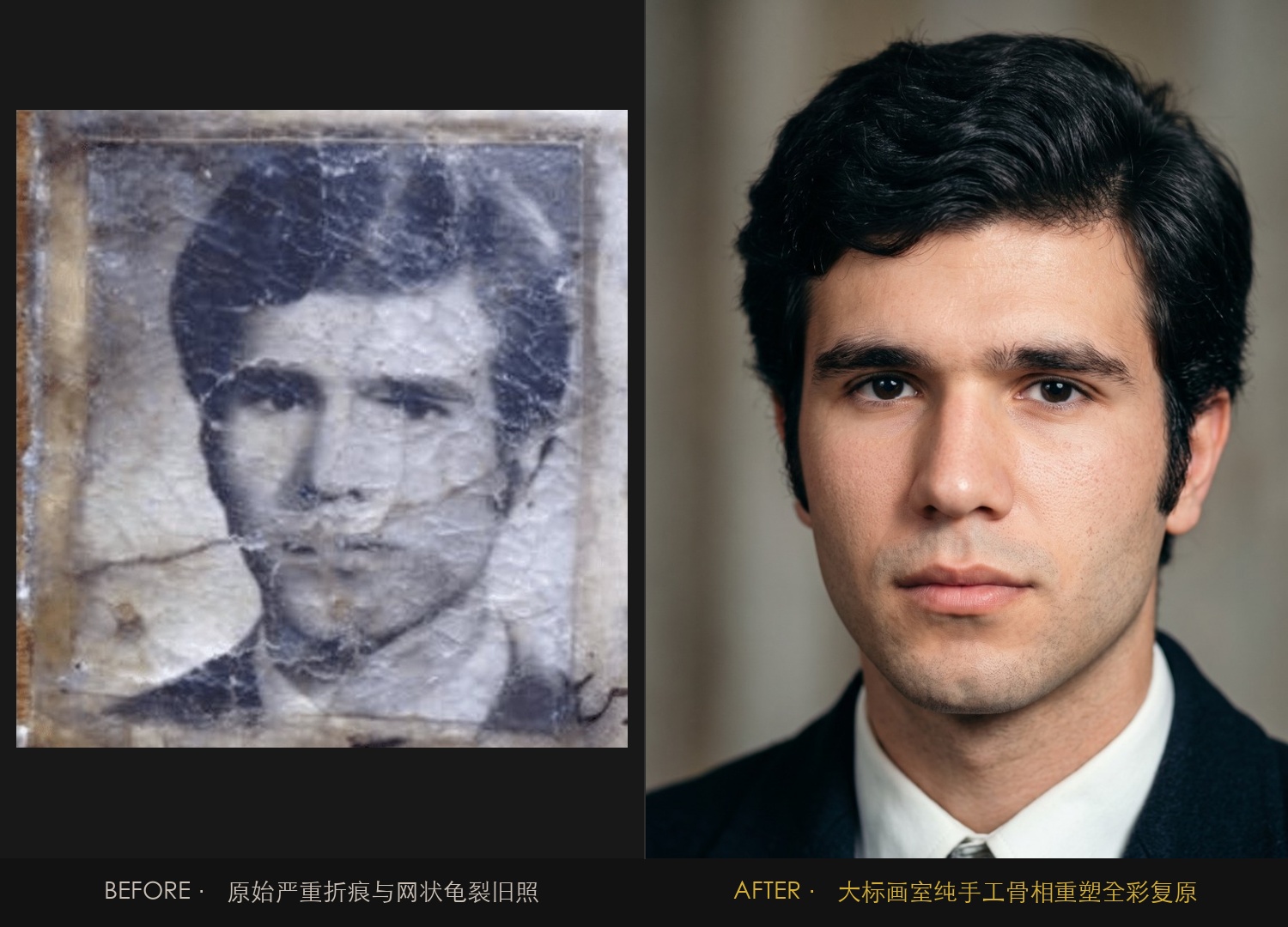
In vintage photograph restoration, small ID cards and wallet portraits represent some of the most severely degraded physical artifacts imaginable. Tucked away inside leather wallets for decades, these heirlooms suffer a relentless combination of body heat, repeated mechanical bending stress, and atmospheric humidity—often resulting in catastrophic structural failure.
Recently, BIGBROSTUDIO took in a classic example: a black-and-white portrait of a young gentleman entirely covered by an intricate network of spiderweb emulsion cracks (craquelure), bisected by two deep physical folding creases across the nose and jawline, and marred by emulsion flaking near the right eye. Prior to contacting us, the owner tried several popular automated 'AI photo restore apps.' The outcome was universally disastrous: melted facial features, hollow black voids where the eyes should be, and skin turned into a lifeless, waxen plastic smear.
True museum-grade restoration of severely damaged photographs is never a matter of applying automated blur filters. It is a rigorous, multi-disciplinary craft encompassing photographic material pathology, optical frequency separation, craniofacial anatomical reconstruction, corneal specular catchlight restoration, and multilayer subsurface scattering hand-colorization. Here, we break down our studio's exact technical protocol.
Left: Original physical photograph with deep creases and emulsion craquelure ➔ Right: Hand-restored and colorized master portrait by BIGBROSTUDIO
I. Physical Pathology Diagnosis: 3 Lethal Damage Mechanisms
Before applying a single stroke, an artist must scientifically diagnose how the photographic emulsion and paper base failed:
- Emulsion Craquelure (Gelatin Silver Breakdown)
Traditional gelatin silver prints comprise three layers: paper substrate, baryta coating (barium sulfate), and the light-sensitive gelatin silver emulsion. Decades of cyclic humidity cause differential expansion between the gelatin and paper base. The embrittled gelatin fractures and curls upward, scattering ambient light into thousands of microscopic white fissures that obscure natural tonal gradients.
- Mechanical Stress Creasing
Repeated folding permanently snaps cellulose fibers within the paper core. Along these fracture lines, emulsion flakes off completely, exposing oxidized base paper and fungal foxing. Horizontal fold lines run across the left cheek and nasal septum, while vertical stress breaks slice through the frontal bone, severing continuous lighting planes.
- Erasure of Anatomical Landmarks
Crucial reference points—the medial canthus, inferior orbital rim, and vermilion border of the lips—were obliterated by cracks. The vital corneal catchlight was masked by reflective debris, giving the gaze a flat, lifeless appearance.
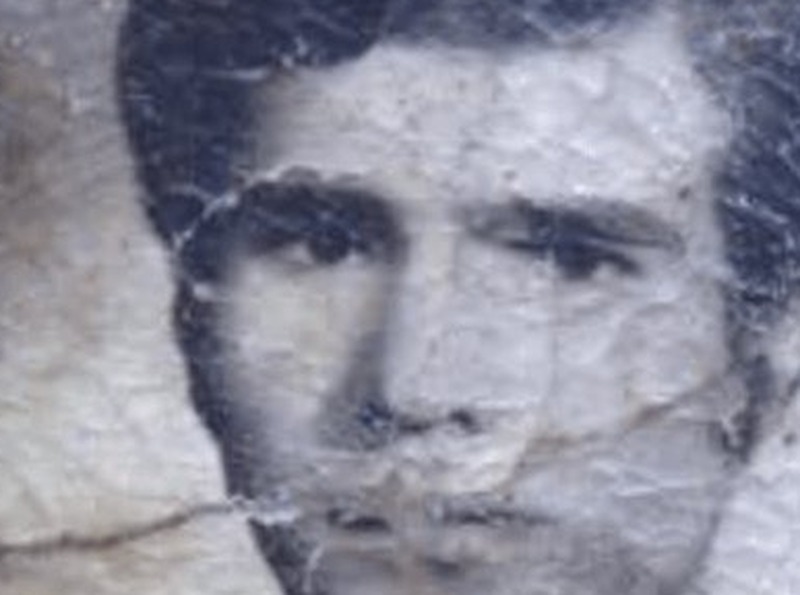 Microscopic detail: Gelatin emulsion craquelure and severed paper fibers traversing the nasal bridge
II. Why Automated AI Apps Inevitably Destroy These Heirlooms
Many ask: if modern generative AI can create hyper-realistic portraits from text prompts, why does it fail so abysmally on damaged family photos?
The fundamental flaw lies in statistical probability. Commercial AI facial enhancement models work via pattern matching and hallucinated feature replacement. Confronted with dense white fissures, the neural network misinterprets craquelure as bright highlights or high-frequency digital noise and runs aggressive Gaussian blurs to smooth them out:
- Plastified Wax Museum Look: High cheekbones and nasal cartilage are pulverized into flat, featureless plains, creating that telltale uncanny valley plastic sheen.
- Identity Theft: Confused by fragmented eye contours, AI grafts generic synthetic eyes and teeth from training datasets onto the subject, replacing your ancestor with an unrecognizable stranger.
- Artifact Halos: Hair strands and silhouette edges develop jarring pixel artifacts and jagged edge halos.
Master Restorer's Axiom: "AI excels at making things up, but harbors zero respect for historical truth. Authentic photograph restoration is not about inventing a new face—it is about reverse-engineering the true person from surviving optical fragments guided strictly by human skeletal anatomy."
III. The Engineering Pipeline: 4 Steps of Pure Artisanal Craft
Step 1: Optical Frequency Separation (Decoupling Texture from Volume)
We split the digitized capture into High-Frequency (Texture/Grain) and Low-Frequency (Luminance/Tone) working layers. On the low-frequency plane, broad facial contours and light volumes are smoothed with soft blurs without affecting surface sharpness. On the high-frequency plane, micro-cloning tools surgically extract crack fissures while transplanting healthy silver halide grain into void zones—eliminating defects while preserving authentic photographic texture.
Step 2: Craniofacial Skeletal Alignment
This subject features strong, defined supraorbital ridges and a prominent nasal dorsum. Guided by the biomechanics of the frontal bone, lateral orbital rims, zygomatic arches, and mandible, our portraitist re-aligns structures displaced by folding stress. We sculpt the triangular highlight on the lower lateral cartilage of the nose and redefine the subtle shadow along the lip closure.
Step 3: Corneal Specular Catchlight Restructuring
The eyes are the mirror of human consciousness. After stripping away scattered surface reflections, we calculate the original window lighting angle and paint a razor-sharp specular reflection at the 11 o'clock position on the cornea. Subtle limbal rings and delicate vascular tones are added to the sclera, restoring an intense, heartfelt gaze.
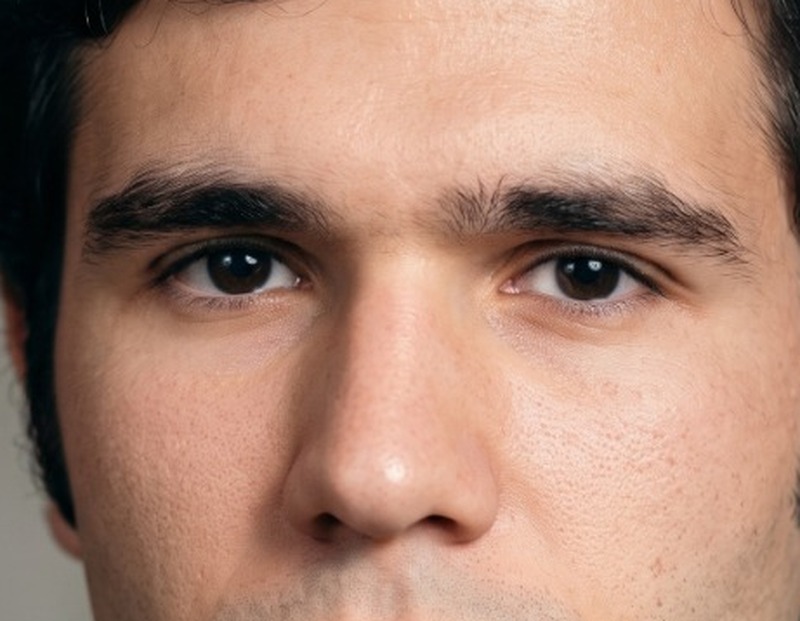 Macro detail: Orbital bone margins, micro-pore texture, and natural five-o'clock shadow
Step 4: Subsurface Scattering (SSS) Multi-Layer Hand Colorization
Monochrome colorization must never be a flat peach tint! The human face exhibits three distinct physiological zones:
- Upper Zone (Forehead): Pale ivory with gentle golden warmth.
- Middle Zone (Cheeks & Nose): Highly vascularized, radiating rose-gold warmth.
- Lower Zone (Chin & Jawline): Cool, muted slate-grey undertones due to follicular hair roots.
Using semi-transparent digital oil glazes, we simulate light penetrating and diffusing within the epidermis before reflecting back, producing an authentic, lifelike human complexion.
IV. Museum Standards & Risk-Free Commission
Family heirlooms represent irreplaceable generational memory. BIGBROSTUDIO adheres to transparent, museum-grade standards:
- $0 Complimentary Preview: Submit a phone snap or scan of your damaged photo. Our artist prepares an initial structural assessment and draft preview—pay only after you are completely satisfied.
- Zero AI Plastic Smoothing: Decades of master draughtsmanship reconstruct bone structure and catchlights at the single-pixel level.
- 300 DPI Lossless Master Deliverables: Delivered as uncompressed TIFF and maximum-quality JPG master files (both monochrome restored and hand-colorized editions), backed by lifetime cloud archiving.
- Instant Global Download: Access your master files directly from your Order Tracking page and secure email links—eliminating overseas shipping delays, customs fees, and the risk of physical parcel damage. Ready for local fine-art giclée printing anytime.
Entrust your precious memories to true hand craftsmanship. Connect with BIGBROSTUDIO today!
Reader Discussions & Patron Stories
Authentic thoughts and artistic conversations. The artist personally replies to every patron when taking a break from the easel.
Join the Discussion
Share your thoughts, the story behind your vintage photo, or ask the artist a question. ABiao replies personally.
Absolutely remarkable work! I had a 1950s wallet photo of my late uncle that suffered an identical fate—a harsh horizontal crease bisecting his nasal bridge. Local photo shops refused it, and commercial AI apps melted his nose into a horrific plastic smear. When I sent it to BIGBROSTUDIO, the preliminary draft preview gave me immediate confidence. Downloading the 300 DPI print-ready master file from my order page, I was stunned: his dignified brow structure and nasal cartilage were reconstructed flawlessly, preserving genuine skin pores and a piercing eye catchlight. Our family is deeply grateful!
This breakdown of frequency separation and craniofacial skeletal reconstruction is fascinating and thorough! My father's 1940s identity photo suffered humidity damage, and an area of emulsion along his lower left eyelid flaked off entirely, exposing bare paper. When key anatomical landmarks are completely obliterated, how does your portraitist accurately deduce and paint the correct eyelid contour without fabricating an unrecognizable stranger?
Your explanation of the three physiological color zones and subsurface scattering is an eye-opener! Most colorized vintage photos look like they were dipped in monotonous yellow wax. If our original photo is black and white, can we specify historical nuances during the initial consultation—such as my grandfather's hazel eye color and dark chestnut hair? Once finalized, how quickly can we download the print-ready master files in Melbourne?